
Zara Bennett · 19 October 2026
Metadata Management Strategies in Multi-User Note Taking Environments
Metadata in multi-user note taking environments encompasses elements such as authorship details, timestamps, tagging structures, access permissions, and relational links between notes, and these components enable coordinated work across distributed teams while maintaining data integrity. Platforms that support simultaneous editing rely on consistent metadata frameworks to track contributions and prevent overlap, and observers note that effective strategies often combine schema standardization with automated validation tools.
Standardization begins with the adoption of common metadata vocabularies that define fields like creator identifiers and modification histories, and research from institutions including the University of Toronto indicates that teams using unified schemas experience fewer synchronization conflicts during peak collaboration periods. Such approaches draw from established data models that assign unique identifiers to each note while embedding contextual attributes, which allows queries to retrieve relevant items without manual sorting.
Permission Metadata and Access Layering
Access control metadata plays a central role in shared environments because it specifies roles for readers, editors, and administrators at the note and folder levels, and systems that update these attributes in real time reduce unauthorized changes. In practice, platforms implement hierarchical permission structures where group-level rules cascade to individual documents, and this method supports scalability as team sizes grow beyond ten members.
Studies conducted by Canadian research groups in 2025 found that metadata-driven permission systems cut down on review cycles by embedding approval workflows directly into note headers. Users receive notifications when permission metadata changes, which keeps all participants aligned without separate communication channels, and integration with directory services such as LDAP or OAuth providers further automates role assignments based on organizational data.
Automated Tagging and Semantic Enrichment
Automated tagging systems extract keywords and categories from note content using natural language processing, and they attach these as metadata attributes that improve retrieval across large repositories. When multiple users contribute to the same note, the system reconciles conflicting tags by weighting recent contributions higher or requiring consensus thresholds, and data from collaborative tool deployments shows this reduces duplication rates substantially.
One approach involves linking notes through relational metadata that records parent-child connections or cross-references, and these links update dynamically as content evolves. As of October 2026, several enterprise platforms have incorporated machine learning models trained on domain-specific corpora to suggest tags that align with industry taxonomies, which streamlines onboarding for new team members who might otherwise spend hours manually categorizing entries.
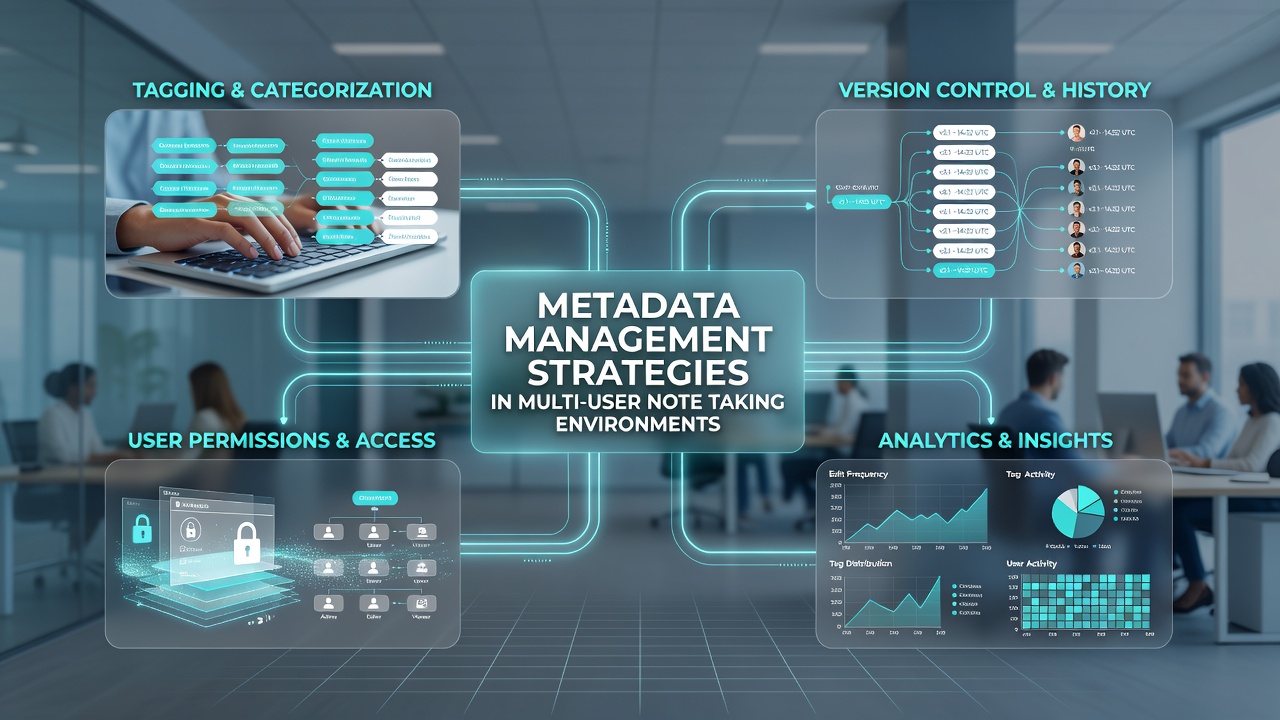
Observers point out that semantic enrichment extends beyond simple keywords to include entity recognition for people, dates, and projects mentioned within notes, and this layer of metadata supports advanced filtering that surfaces related items across user accounts. European research initiatives have documented gains in search precision when platforms apply these techniques consistently, and the resulting metadata remains queryable even after notes migrate between different storage backends.
Synchronization Protocols for Metadata Consistency
Real-time synchronization of metadata requires protocols that propagate changes across clients without overwriting concurrent edits, and operational transformation techniques handle this by sequencing updates according to timestamps and user priorities. Teams that deploy conflict detection algorithms based on metadata hashes report lower instances of data divergence, and integration with event sourcing architectures logs every metadata alteration as a discrete event that can be replayed for auditing purposes.
Industry reports from the Data Governance Institute highlight that organizations adopting these protocols maintain audit trails that meet compliance requirements in regulated sectors, and the trails capture details such as who altered a tag or extended sharing rights at specific moments. When networks experience latency, metadata queues buffer pending changes until connectivity resumes, and this buffering preserves order while notifying users of any queued actions that require review.
Privacy Controls Embedded in Metadata
Privacy metadata specifies retention periods, anonymization flags, and sharing restrictions that travel with each note, and platforms enforce these rules through automated expiration processes that remove or redact content once deadlines pass. In multi-user settings, these attributes help satisfy data protection regulations by ensuring that sensitive information does not persist beyond approved windows, and linkage to external policy engines allows dynamic updates when regulations shift.
Academic papers from Australian universities have examined how metadata schemas that include consent tracking improve transparency for participants in collaborative projects, and such schemas record which users granted access along with the scope of that access. The resulting records support compliance audits without requiring separate documentation, and they integrate with broader data lifecycle management tools that handle archival and deletion across environments.
Conclusion
Metadata management in multi-user note taking environments continues to evolve through combinations of standardized schemas, automated enrichment, and robust synchronization methods that address both operational and regulatory demands. Organizations that invest in these strategies gain reliable coordination across teams while preserving the integrity and accessibility of shared content over time, and ongoing developments in October 2026 reflect broader industry movement toward integrated governance frameworks that span multiple platforms and jurisdictions.